Sound Research WIKINDX

Sound Research WIKINDX |
|
|
Displaying 1 - 20 of 20 Parameters |
| Boden, M. A. (2011). Creativity & art: Three roads to surprise. Oxford: Oxford University Press. |
  
|
| Added by: alexb44 Last edited by: Mark Grimshaw-Aagaard 19/11/2025, 00:40 | |
| "Some aesthetic values (as suggested in Chapter 4) may be enduring, because they are part of our biological heritage. But many are culturally based. [...] Values in general, whether enduring or not, can’t be justified—even though they may sometimes be explained—in scientific terms. In that sense, and in that sense alone, both creativity and art lie for ever beyond the reach of science." | |
| "Creativity is the ability to come up with ideas or artefacts that are new, surprising, and valuable." | |
| "P-creativity involves coming up with a surprising, valuable idea that’s new to the person who comes up with it. It doesn’t matter how many people have had that idea before. But if a new idea is H-creative, that means that (so far as we know) no one else has had it before: it has arisen for the first time in human history." | |
|
"An idea may be surprising because it’s unfamiliar, or even unlikely— like a 100-to-1 outsider winning the Derby. This sort of surprise goes against statistics. The second sort of surprise is more interesting. An unexpected idea may ‘‘fit’’ into a style of thinking that you already had—but you’re surprised because you hadn’t realized that this particular idea was part of it. Maybe you’re even intrigued to find that an idea of this general type fits into the familiar style. And the third sort of surprise is more interesting still: this is the astonishment you feel on encountering an apparently impossible idea. It just couldn’t have entered anyone’s head, you feel—and yet it did. It may even engender other ideas which, yesterday, you’d have thought equally impossible. What on earth can be going on?" |
|
| What is valuable is more difficult to say. "Our aesthetic values are difficult to recognize, more difficult to put into words, and even more difficult to state really clearly" and values change across cultures, from subculture to subculture, and so on, even within science where descriptions can be vague or the value placed on a hypothesis (worthwhile or not and within what context) can vary. "Because creativity by definition involves not only novelty but value, and because values are highly variable, it follows that many arguments about creativity are rooted in disagreements about value." | |
There are three paths to creativity:
|
|
| Boden, M. A. (2016). AI: Its nature and future. First edition ed. Oxford: Oxford University Press. |
|
| Added by: alexb44 Last edited by: alexb44 21/09/2026, 02:54 | |
|
Boden makes the case for virtual machines - the implied systems that run on the hardware. The hardware might be a bottleneck, but ultimately the system is most important.
A funny contrast to the promises of LLMs scaling laws that have gradually faded away. . . |
|
|
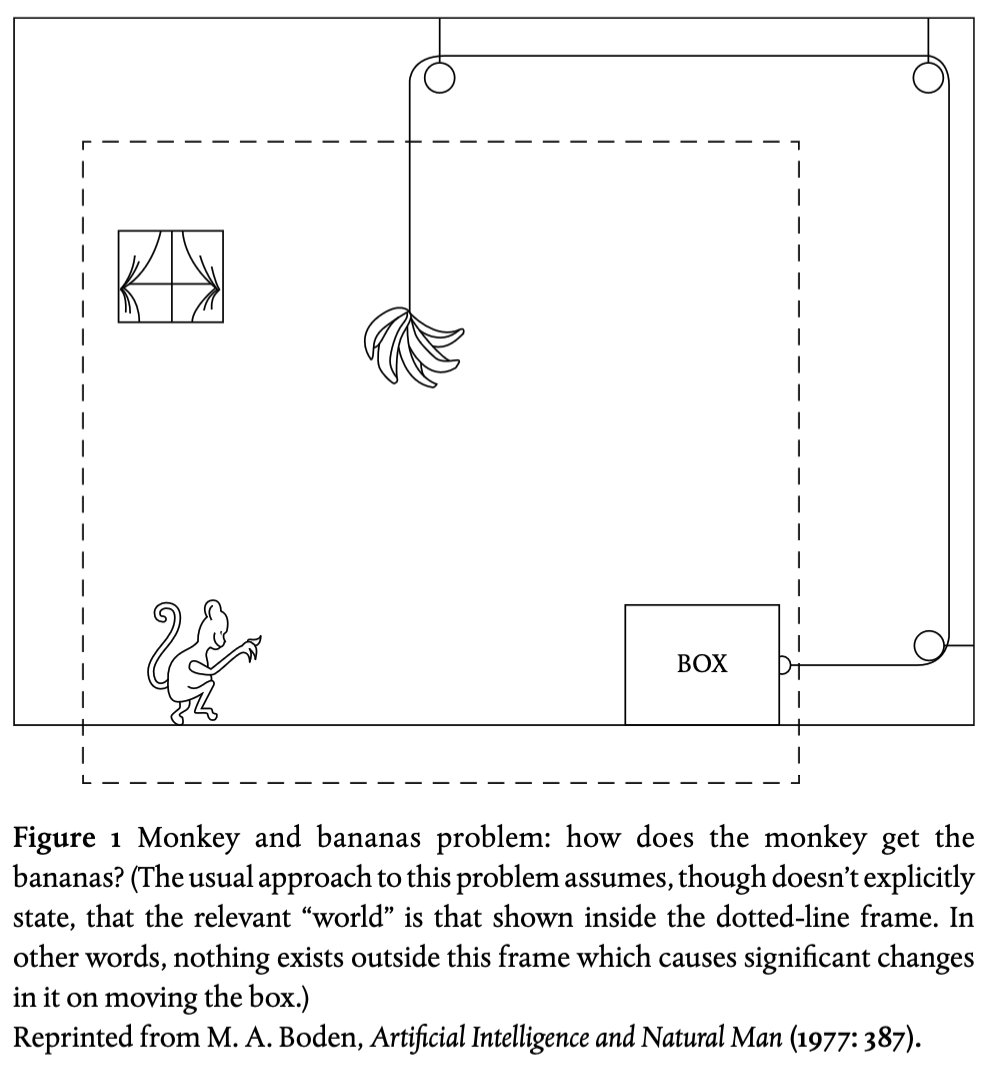
The Frame Problem
AI does not have a human's sense of relevance, look at Boden's funny example: "My own favorite example is: If a man of twenty can pick ten pounds of blackberries in an hour, and a woman of eighteen can pick eight, how many will they gather if they go blackberrying together? For sure, “eighteen” isn’t a plausible answer. It could be much more (because they’re both showing off) or, more probably, much less. This example was even more telling fifty years ago, when I first encountered it. But why is that? Just what kinds of knowledge are involved here? And could an AGI overcome what appear to be the plain arithmetical facts?"
|
|
|
"Human-level AGI would involve distributed cognition"
While I understand the connection, it falls flat for me in the sense that there is no such thing as a sociocultural existence for AI agents, so there can be no distinction between them really... It seems to me to be a way of thinking about the problem rather than being an actual part of the problem, precisely because a hypothetical AGI would not have the limitations of humans, so once the system is in place, it would theoretically operate as one and would not actually need distributed cognition. |
|
|
Deep Learning is not the end all be all.
"However (as remarked at the outset of this chapter), full AGI would do very much more. Difficult though it is to build a high-performing AI specialist, building an AI generalist is orders of magnitude harder. (Deep learning isn’t the answer: its aficionados admit that “new paradigms are needed” to combine it with complex reasoning—scholarly code for “we haven”t got a clue”.)" While some still believe LLMs to be the path to AGI, several researchers are leaving this path - LeCun, Sutton and Silver. . . |
|
|
"Some areas of AI seem especially challenging: language, creativity, and emotion. If AI can’t model these, hopes of AGI are illusory"
|
|
|
AI can create things that can be deemed creative in Boden's terms:
"In particular, there are very few combinational systems. One might think it’s easy to model combinational creativity. After all, nothing could be simpler than making a computer produce unfamiliar associations of already stored ideas. The results will often be historically novel, and (statistically) surprising. But if they’re also to be valuable, they must be mutually relevant. That’s not straightforward, as we’ve seen. The jokegenerating programs mentioned in Chapter 2 use joke templates to help provide relevance. Similarly, symbolic AI’s case-based reasoning constructs analogies thanks to precoded structural similarities. So, their “combinational” creativity has a strong admixture of exploratory creativity as well." I still maintain that AI's inablity to judge its own output makes the claims of creativity dubious. Humans will often judge their own outputs inaccurately, but they judge them none-the-less, and I think that the framing problem is equally relevant here. |
|
|
"AI has enabled human artists to develop a new art form: computergenerated (CG) art. This concerns architecture, graphics, music, choreography, and—less successfully (given NLP ’s difficulties with syntax and relevance)—literature. In CG art, the computer isn’t a mere tool, comparable to a new paintbrush, helping the artist to do things they might have done anyway. Rather, the work couldn’t have been done, or perhaps even imagined, without it."
This is a false equivalence, in my opinion. Before the paint brush came similar tools, which ultimately led to somebody imagining it in the first place. The very first imagining of what kind of a painting the paint brush would produce is probably very far from the refined concept of painting that we have today, but it could still all be traced further back. Perhaps to chalk on a cavewall, or to cutting in a tree - nevertheless these things paved the way, and at some point the very idea of imagining something as simple as a painting would've been equally unimaginable. What makes the claim to the 'uninmaginativeness' of computer-generated art stronger in this case is that the digital domain does not abide by physical rules, and as such our ability to imagine in the days of less advanced computers was significantly more limited. I can now readily imagine countless different types of CG visual art because we now have cognitive models that allow me to imagine it. Even then, this imaginativeness must have been gradual, but yet with someone having a rough imagination of what drawing on the computer might look like. Once realising a simple version of this, their ability to imagine these artworks gradually expand, so ultimately I see no difference between this example and of other tools. It is a tool all the same, and the argument of "more-than" in this case is not strong. |
|
|
"MINDER indicates some ways in which emotions can control behavior, scheduling competing motives intelligently. A human nursemaid, no doubt, will experience [sic] various types of anxiety as her situation changes. But the point, here, is that emotions aren’t merely feelings. They involve functional, as well as phenomenal, consciousness (see Chapter 6). Specifically, they are computational mechanisms that enable us to schedule competing motives—and without which we couldn’t function. (So the emotionless Mr. Spock of Star Trek is an evolutionary impossibility.)
If we are ever to achieve AGI, emotions such as anxiety will have to be included—and used" While I agree, I think Boden's view here is too strongly suggesting that 'using' emotions as computational mechanisms can really be considered anything like real emotions, and would be severely limited in comparison. Ultimately all this is doing is mimicking the behaviour by introducing something more analogous to a decision tree than actual emotion, making it rather ambiguous. Shouldn't the goal of AGI be a little more lofty than this? Let's even assume we actually program an AGI capable of these computational modes of emotion - how are they regulated and balanced? Human emotions can be both productive and destructive, and that is often a claim to human inferiority as opposed to machines (although hypothetical ones), but humans would still be in charge of determining how they shold be distributed in various situations. Here the AI scientist will point to AGI's potential super ability to determine what is most suitable given literally any situation (which would suggest ASI, not just AGI), but that takes actual emotion to decide, and it isn't necessarilly a process of active reflection, but rather intuition that takes over, so we're back where we started.
|
|
|
"Anyone interested in AGI should note that those few AI scientists who have seriously considered the computational architecture of the mind as a whole accept hybridism unreservedly. They include Allen Newell and Anderson (whose SOAR and ACT * were discussed in Chapter 2), Stan Franklin (whose LIDA model of consciousness is outlined in Chapter 6), Minsky (with his “society” theory of mind25), and Aaron Sloman (whose simulation of anxiety is described in Chapter 3).
In short, the virtual machines implemented in our brains are both sequential and parallel. Human intelligence requires subtle cooperation between them. And human-level AGI, if it’s ever achieved, will do so too." Hybridism is an absolute necessity, and so the idea of any definition of AGI that assumes the mind as separate from the body is of no use. (Arxiv 2025 paper re. AGI definition assumes exactly this...) This further stresses the importance of embodiment or embodied intelligence, which is also what Sutton and Silver, and Lecun are gravitating towards (though without the proper reasoning to boot). |
|
|
Female crickets - biological sensing vs robotic "registering".
|
|
Boden is positive about AI, but also realistic."Skepticism DefendedIn my judgement, the S-skeptics are right. The discussion of mind-as-virtual-machine in Chapter 6 implied that there is no obstacle in principle to human-level AI intelligence (possibly excepting phenomenal consciousness). The question here is whether this is likely in practice. Besides the intuitive implausibility of many post-Singularity predictions, and the near-absurdity (imho) of transhumanist philosophy, the S-skeptics have other arguments on their side. AI is less promising than many people assume. Chapters 2 through 5 mentioned countless things that current AI cannot do. Many require a human sense of relevance (and tacitly assume completion of the semantic web: see Chapter 2). Moreover, AI has focused on intellectual rationality while ignoring social/emotional intelligence—never mind wisdom. An AGI that could interact fully with our world would need those capacities, too. Add the prodigious richness of human minds, and the need for good psychological/computational theories about how they work, and the prospects for human-level AGI look dim. Even if it were practically feasible, it’s doubtful whether the necessary funding would materialize. Governments are currently putting enormous resources into brain emulation (see the following section), but the money required for building artificial human minds would be much greater still. Thanks to Moore’s Law, further AI advances can certainly be expected. But increases in computer power, and in data availability (given cloud storage, and 24/7 sensors throughout the Internet of Things), won’t guarantee human-like AI. That’s bad news for S-believers, because ASI needs AGI first. S-believers ignore the limitations of current AI. They simply don’t care, because they have a trump card: the notion that exponential technological advance is rewriting all the rule books. This licenses them to make predictions at will. They occasionally allow that “by-end-of-the-century” predictions may be unrealistic. However, they insist that “never” is a long time. Never is indeed a long time. So the S-skeptics, myself included, may be wrong. They have no knock-down argument— especially if they allow AGI’s possibility in principle (as I do). They may even be persuaded that the Singularity, albeit hugely delayed, will happen eventually. Nevertheless, careful consideration of state-of-the-art AI gives good reason to back the skeptics’ hypothesis (or their bet, if you prefer), rather than the wild speculations of the S-believers."
|
|
|
AGI would require social/emotional intelligence and wisdom
"Moreover, AI has focused on intellectual rationality while ignoring social/emotional intelligence—never mind wisdom. An AGI that could interact fully with our world would need those capacities, too. Add the prodigious richness of human minds, and the need for good psychological/computational theories about how they work, and the prospects for human-level AGI look dim" |
|
|
Boden is a skeptic as well. "In my judgement, the S-skeptics are right. The discussion of mind-as-virtual-machine in Chapter 6 implied that there is no obstacle in principle to human-level AI intelligence (possibly excepting phenomenal consciousness). The question here is whether this is likely in practice. Besides the intuitive implausibility of many post-Singularity predictions, and the near-absurdity (imho) of transhumanist philosophy, the S-skeptics have other arguments on their side." |
|
|
Hardware advances are not enough—the 'virtual machine' is still the main thing.
"it is the virtual machine that’s crucial here (see Chapters 1 and 6). Some virtual machines can be implemented only in hugely powerful hardware. So mega-transistored computer chips may well be necessary. But just what computations will they be performing? In other words, just what virtual machines will be implemented in them? To match human (or even mouse) intelligence, these will need to be informationally powerful, in ways that computational psychologists don’t yet fully understand. Let’s suppose—what is, I think, unlikely—that every neuron in a human brain will, eventually, be mapped. In itself, this won’t tell us what they are doing. (The tiny nematode worm C. elegans has only 302 neurons, whose connections are known precisely. But we can’t even identify the synapses as excitatory/inhibitory.)"
The nematode worm is fully mapped, but we don't understand the synapses fully. Even if we did, would it be a nematode worm? (as it relates to the physicalist view)
|
|
|
Virtual machines are required for every little thing "Even the mundane activity of eating with a knife and fork requires that many virtual machines be integrated—some dealing with physical objects (muscles, fingers, utensils, various kinds of sensors), others with intentions, plans, expectations, desires, social conventions, and preferences. To understand how that activity is possible, we need not only neuroscientific data about the brain, but also detailed computational theories about the psychological processes involved."
Assuming that all these things add up to an understanding of the task is still banking entirely on emergence of a mind through these little bits and pieces. There is still no intentionality (Merleau-Pontian), let alone Searly intentionality. |
|
|
AI has no understanding of human relevance - it would require intentionality, once again.
"Like the fisherman in the fairy story, whose wish for his soldier-son to come home was granted by his being brought back in a coffin, we could be nastily surprised by powerful AI systems lacking our understanding of relevance."
|
|
| Buehner, M. J. (2010). Temporal binding. In A. C. Nobre & J. T. Coull (Eds.), Attention and Time. Oxford: Oxford University Press. |

|
| Added by: Mark Grimshaw-Aagaard 14/11/2018, 09:15 | |
| Casati, R., & Dokic, J. (2009). Some varieties of spatial hearing. In M. Nudds & C. O'Callaghan (Eds.), Sounds & Perception. (pp. 97–110). Oxford: Oxford University Press. |
|
| Added by: Mark Grimshaw-Aagaard 01/02/2014, 11:15 | |
| The Located Event Theory of Casati and Dokic: "sounds are located at their sources, and are identical with, or at least supervene on, the relevant physical processes in them" | |
| "[a] principle of classification of metaphysical theories of sounds can be based on the alleged location each theory assigns to sounds" | |
| Cohen, A. J. (2002). Music as a source of emotion in film. In P. N. Juslin & J. A. Sloboda (Eds.), Music and Emotion: Theory and Research. (pp. 249–272). Oxford: Oxford University Press. (Original work published 2001). |
|
| Added by: Mark Grimshaw-Aagaard 02/09/2005, 12:50 | |
| Diegesis (2005). In Oxford English Dictionary Online. Oxford: Oxford University Press. |
|
| Added by: Mark Grimshaw-Aagaard Last edited by: Mark Grimshaw-Aagaard 01/02/2006, 15:16 | |
| "The narrative presented by a cinematographic film or literary work; the fictional time, place, characters, and events which constitute the universe of the narrative." | |
| Evans, D. (2001). Emotion: A very short introduction. Oxford: Oxford University Press. |
|
| Added by: Mark Grimshaw-Aagaard 28/05/2011, 07:52 | |
| Ekman's basic universal, innate emotions include: joy; distress; anger; fear; surprise; disgust. "They are of rapid onset and last a few seconds at a time." | |
| "The universality of basic emotions argues strongly for their biological nature." | |
| Some emotions are learned and culturally specific. Perhaps such emotions exist to "help people to cope with the particular demands of their culture." (p.15) | |
|
"...fear is probably one of the first meotions to have ever evolved." All animals descended from the first vertebrates have the capacity for fear. |
|
| "Some memories seem so fresh and vivid when we recall them that we may have the impression of reliving the event exactly as it happened, but this is an illusion caused by the power of our imaginative reconstruction. When we compare such recollections with those of others who were in the same place at the same time, we may find that the accounts differ markedly, while the differing versions seem equally vivid and real to each person." | |
| A continuum betwee basic, innnate emotions and learned emotions. Fear and anger, for examplem very innate and very basic. Romantic love, as an emotion: unclear whether basic or learned. Some claim it is a Mediaeval invention but others find evidence for it in texts such as the Old Testament. It's also been observed in non-Western societies.. However, emotions such as romantic love can be "played out slightly differently in different cultures" (p.19). | |
| Possibly a third category of emotions -- 'higher cognitive emtotions' e.g. love. It is universal and innate (to a degree) but typically grows slowly (unlike fear and anger). Such emotions are associated with the neocortex rather than in the subcortical strucutres of the brain. The neocortex supports high level complex cognition such as logical analysis. Emotions derived here may be "influenced by conscious thoughts and this in turn is probably what allows higher cognitive emotions to be more culturally variable than the basic emotions" (p.20). | |
|
Other higher cognitive emotions might be jealousy, envy, pride, embarrassment, shame, guilt as well as love. All of these are fundamentally social unlike basic emotions. "Some basic emotions can also be co-opted for the social functions that typify higher cognitive emotions." (p.21). e.g. disgust at a rotting body's smell (non-social function keeps you away from disease) or disgust at incest or paedophilia (social function). |
|
| Two pathways related to fear in the brain. The shorter leads to quicker responses but can be wrong -- e.g. false fire alarms. The second is longer and slower, passsing through the sensory cortex allowing us to consider the risk and to cut off the initial fear response if the danger is not real. | |
| Internal response lead to particular courses of action, external emotional expression allows others to learn from our experience. | |
| Internal feelings and external expressions must be taken into account in a consideration of the evolution of emotions. | |
|
The higher cognitive emotions, guilt, love, revenge etc., "seem to exhibit a kind of 'global rationality' that saves pure reason from itself" (p.36). Robert Frank says that such emotions, which evolved later than the basic emotions, are related to commitment issues. e.g. facial expressions of guilt demonstrate untrustworthiness -- if you can be trusted, others are more happy to work with you. Signs of love demonstrate commitment to another. A reputation for revenge means you will be less likely to be a victim. |
|
|
Moods (e.g. happiness) are long-term and increase our susceptibility to emotions (e.g. joy). Equally, a mood such as happiness may protect us from distress. Moods are background states. |
|
| Stories provide emotional satisfaction by providing social information. Yet the information is false Perhaps they work by providing information about the narrator -- his/her intelligence. | |
| Remembering is never precise because items in memory are not recorded in their fine details. They are filed under keywords; these are extrcted and "educated guesswork" fills in the blanks. "It is more like reconstrcuting an antique pot from a few broken shards than replaying an old movie" (p.80). | |
| If consciousness depends on the capacity for subjective feelings and subjective feeling depend on the form of body one has, computer programs will always lack consciousness if they remain virtual. Hence 'evolutionary robotics' and 'embodied programs'. | |
| Subjective feeling that is the basis for consciousness is "the essence of true emotion" (p.116) and consciousness is arrived at through embodiment (which leads to subjective feeling). Will robots feel differently to themselves than humans observe their behaviours (and thus inferred) feelings to be? Will they experience the same emotions or the same mix of emotions? If not, could there be empathy between robot and human (p.119)? | |
| Re John Searle's thought experiment, the Chinese Room. A man in a room has a set of rules for responding to Chinese inscriptions that are given to him. Based on these responses, people outside the room believe the man knows the Chinese language. He doesn't though. Searle argues a computer is like this -- it only interprets, it never knows therefore could never become conscious. | |
| Nudds, M. (2009). Sounds and space. In M. Nudds & C. O'Callaghan (Eds.), Sounds & Perception. (pp. 69–96). Oxford: Oxford University Press. |
|
| Added by: Mark Grimshaw-Aagaard 01/02/2014, 11:09 | |
| "[sound] is wholly instantiated wherever it is instantiated, including where we are" | |
| "sounds are patterns or structures of frequency components instantiated by sound waves" | |
| O'Callaghan, C. (2007). Sounds. Oxford: Oxford University Press. |
|
| Added by: Mark Grimshaw-Aagaard 09/05/2013, 09:23 | |
| O'Callaghan, C. (2009). Sounds and events. In M. Nudds & C. O'Callaghan (Eds.), Sounds & Perception. (pp. 26–49). Oxford: Oxford University Press. |
|
| Added by: Mark Grimshaw-Aagaard Last edited by: Mark Grimshaw-Aagaard 27/08/2026, 07:50 | |
| "sounds are particular events of a certain kind. They are events in which a moving object disturbs a surrounding medium and sets it moving. The strikings and crashings are not the sounds, but are the causes of sounds. The waves in the medium are not the sounds themselves, but are the effects of sounds." | |
| "Sounds are events that take place near their sources, not in the intervening space." | |
| "Sounds are stationary relative to their sources" | |
| "[T]here is the event of an object or substance setting a medium into periodic motion. This is sound." | |
|
O'Callaghan presents 3 theories of sound: 1. Sounds are properties of bodies. A view held from Locke onwards -- bodies and objects possess sounds when they vibrate at particular frequencies and amplitudes. 2. Classic acoustic theory. Sounds are waves produced by vibrating bodies -- thus, we do not immediately hear the property a body 'possesses' but only hear the sound as a compression wave through a medium. 3. Sounds are events. O'Callaghan arrives at the 'event view' of sound from Aristotle's writings: sound is a movement (as per Aristotle) but O'Callaghan interprets this as -- the movement need not be the medium but can be the event that causes the medium's disturbance/movement. Sound is 'the act of one thing moving another' (p.27). cf Aristotle (Arisotle 350 BCE). |
|
| O'Shaughnessy, B. (2009). The location of a perceived sound. In M. Nudds & C. O'Callaghan (Eds.), Sounds & Perception. (pp. 111–125). Oxford: Oxford University Press. |
|
| Added by: Mark Grimshaw-Aagaard 01/02/2014, 11:14 | |
| sound moves through space because it is the transferal of physical force; there is an "essential spatio-temporal dynamism of sound" | |
| Pearsall, J. (Ed.). (1999). Concise Oxford English dictionary. 10th ed. Oxford: Oxford University Press. |
|
| Added by: Mark Grimshaw-Aagaard Last edited by: Mark Grimshaw-Aagaard 20/06/2006, 08:11 | |
| Ecology: "the branch of biology concerned with the relations of organisms to one another and to their physical surroundings" | |
| Environment: "the surroundings or conditions in which a person, animal, or plant lives or operates" | |
| Poincaré, H. (1910). Mathematical creation. The Monist, 20(3), 321–335. |
|
| Added by: Mark Grimshaw-Aagaard Last edited by: Mark Grimshaw-Aagaard 01/08/2022, 11:16 | |
| Santarcangelo, V., & Terrone, E. (2015). Sounds and other denizens of time. The Monist, 98(2), 168–180. |
|
| Added by: Mark Grimshaw-Aagaard Last edited by: Mark Grimshaw-Aagaard 09/01/2024, 12:21 | |
| "A purely temporal individual entity is such that we can establish when but not where it is. One can think of these individuals (for example, a sound) as having only temporal parts and temporal features in spite of their being dependent on more basic entities that have also spatial features (such as a body emitting the sound). But could such individuals exist entirely independently of any commitment to space? Strawson explores a positive answer to this question in chapter II of his Individuals, by means of a thought experiment concerning what he calls a No-Space world. In the first instance, this experiment aims at putting pressure on the Kantian thesis that space is a necessary condition for any “objective” experience, by which he means any experience of individual entities as existing independently of their being experienced. Strawson, however, adopts the Aristotelian view according to which our most basic schemes and categories provide us with crucial clues as to the basic structures of reality, and thus he conceives space and time as structures of reality and not just as forms of experience. Given our experience of the world, the world must be such that it makes this kind of experience possible. So, Strawson is here discussing the thesis that space is a necessary condition not only for any objective experience, but also for any objective reality." | |
| "It is worth noting that sounds are here just the means to the end of investigating an ontological claim about space and time. Strawson is not making an empirical claim in the philosophy of perception about the nature of hearing in human beings. Nor is he making an ontological claim addressing questions like: are sounds individuals? are they events? are they properties of sounding objects? Rather, he is building up a thought experiment aimed at testing the metaphysical claim according to which the notion of space is necessary for any conception of an objective reality." | |
| Scruton, R. (2009). Sounds as secondary objects and pure events. In M. Nudds & C. O'Callaghan (Eds.), Sounds & Perception. (pp. 50–68). Oxford: Oxford University Press. |
|
| Added by: Mark Grimshaw-Aagaard 07/02/2014, 13:10 | |
| Sounds are "secondary objects and pure events" | |
| "we do not attribute the secondary qualities of sounds to the bodies that emit them, nor to events that occur in those bodies" | |
| A secondary object is "an object all of whose properties are ways in which it feels" | |
| For Scruton, sounds are secondary objects because they are "a real part of the objective world" and not a mere "subjective impression" | |
| With an Aristotelean conception of substance, an event is described by the objects taking part in it and the changes undergone by those objects as the event occurs. Thus, such a view of events is that they are "transformations undergone by particulars" | |
| A pure event does not happen to any thing, it "cannot be reduced to changes undergone by reidentifiable particulars" | |
| Our natural inclination to describe sounds in terms of their source "is not essential to the identification of the sound" | |
| "The physicalist view banishes to the margin those features of sound that make sound so important to us, not only epistemologically, but also socially, morally, and aesthetically. In particular, it does not recognize the 'pure event' as a distinct ontological category, and one that introduces unique possibilities of communication." | |
| Scruton uses examples and explanation of sound grouping/streaming (cf Bregman) to support his view of sounds as pure events because such auditory grouping needs no "bridges to the physical world" in the way that visual Gestalt figures do. | |
| "pure events contain within themselves the principles whereby they can be ordered ... all without stepping into the order of things. | |
| "the 'acousmatic' experience of sound [where sounds are] emancipated from their causes" | |
| Secondary qualities are the way things feel -- not primary qualities that are physical and can be objectively measured. Secondary qualities allow us to discriminate between phenomena such as sounds. | |
| Scruton supports his view that sounds are separate from the objects that emit them with examples such as radio and recording -- acousmatic sound. In such a case, sounds can be grouped (streamed) together coherently without reference to their physical origin. | |
| To Scruton, sound's independence from the physical world leads to a coherence (grouping, streaming) that is a 'virtual causality'. It bears no relation to the process by which sounds are formed. | |
| Sloboda, J. A., & Juslin, P. N. (2002). Psychological perspectives on music and emotion. In P. N. Juslin & J. A. Sloboda (Eds.), Music and Emotion: Theory and Research. (pp. 71–104). Oxford: Oxford University Press. (Original work published 2001). |
|
| Added by: Mark Grimshaw-Aagaard 01/11/2010, 02:55 | |
| Description of vitality affects that are human feelings or qualities related to intensity, shape, contour and movement but that are not emotions themselves. They can occur concurrently with emotions or in their absence and are common to all types of expression. | |
| Szabó Gendler, T. (2010). Intuition, imagination, & philosophical methodology. Oxford: Oxford University Press. |
|
| Added by: Mark Grimshaw-Aagaard Last edited by: Mark Grimshaw-Aagaard 21/10/2023, 06:42 | |
| "[A] thought experiment is just a process of reasoning carried out within the context of a well-articulated imaginary scenario in order to answer a specific question about a non-imaginary situation." | |
| Quoting Thordyke (1922, p.33) "the mind is ruled by habit throughout" and reasoning is no more than "the organization and cooperation of habits." | |
| "...by presenting context in a suitably concrete or abstract way, thought experiments may recruit representational schemas that were previously inactive. As a result, they may evoke responses that run counter to those evoked by alternative presentations of relevantly similar content." | |
| "...imaginative content is taken to be governed by the same sort of restrictions that govern believed content" -- mirroring in pretense-episodes. | |
| Belief is a "receptive attitude whereas pretense is a productive attitude". In the former, the person responds "to something in the world itself" whereas, in the latter, the person projects "something onto the world". | |
|
"..."priming" and thinking about affect both pattern-recognition and perceptual interpretation". cf the Availability Heuristic -- "judgments concerning the likelihood or relative frequency of events or objects" are made according to the 'availability' of such events and objects to memory, perception and imagination. |
|
| Contagion: "...the evocation of perceptual and evaluative schemata is relatively indifferent to whether the evocation occurs as a result of something in the ambient environment, something in memory, or something brought to mind merely as a result of imaginative rehearsal. In all these cases, the consequent availability of the object, event, or schema plays a central role in subsequent attention, perception, and even reasoning." | |
| "The rule-based governedness of generative principles is part of what allows us to structure imaginative space in a way that lets us make sense of its content." | |
| Imaginative resistance: "the puzzle of explaining our comparative difficulty in imagining fictional worlds that we take to be morally deviant." | |
| "The trick that allows an author complete freedom in dictating whether or not character A murders character B is much less effective if what the author wants to dictate is that the murder is, for instance, praiseworthy, or noble, or charming, or admirable. So the puzzle is this: what explains why a trick so effective in so many realms is relatively ineffective here?" | |
| "whether or not we are inclined to respond with imaginative resistance [depends on] why we think we're being asked to imagine [certain scenarios]." | |
|
With regard to realistic fiction, non-distorting fiction, things can be learned and exported from the fictional world to the actual world, adding them to a stock of knowledge about the world. "cases that evoke genuine imaginative resistance will be cases where the reader feels that she is being asked to export a way of looking at the actual world which she does not wish to add to her conceptual repertoire." (p.199) |
|
| "For a story to even make sense, a great number of things that are held to be true within the fiction must be held to be true outside it, and vice versa." This includes moral principles | |
| Re imaginative resistance: "The Impossibility Hypothesis traces the failure to a problem with the fictional world. It says essentially: we are unable to follow the author's lead because the world she has tried to make fictional is impossible. My alternative proposal traces it to a problem with our relations to the actual world. It says essentially: we are unwilling to follow the author's lead because in trying to make that world fictional, she is providing us with a way of looking at this world that we prefer to not to embrace." | |
| "imagination requires a sort of participation that mere hypothetical reasoning does not." | |
| "imagination is distinct from belief on the one hand and from mere supposition on te other. It is this which explains both our general capacity to imagine morally deviant situations and our general unwillingness to do so." | |
| "mental representations can be activated in a multitude of ways, and [...] awakening the associative patterns linked with a particular stereotype, mental image, or protocol, or motor routine tends to awaken the perception and action dispositions associated with it." | |
| "we countenance all sorts of combination as being true in fiction, and credit ourselves with having imagined them, even though we are in no position to make full sense of what that combination would amount to. It is crucial to realize that if one refuses to grant this, one has basically opted out of the fiction game altogether." | |
|
Explaining the 'paradox of fictional emotions' which "involves a jointly inconsistent but individually plausible trio of claims. According to the paradox, it is simultaneously true that a) we have genuine and rational emotional responses towards certain imaginary characters and situations while b) believing those characters and situations to be purely fictional. But it is also true that c) in order for us to have a genuine and rational emotional responses towards a character (or situation), we must not believe that the character (or situation) is purely fictional." SG rejects the 3rd of these conditions in this chapter. |
|
| SG follows the work of Antonio Damasio and Paul Harris in suggesting that it is not necessary to believe situations and characters to be non-fictional in order to have real emotional responses towards them. "Rather, we will suggest, our cognitive architecture is such that without the tendency to feel (something relevantly akin to) real emotions in the case of merely imagined situations, we would be largely unable to engage in practical reasoning." | |
| Dealing with imaginative contagion: "cases where merely imagining or pretending that P has effects that we would expect only perceiving or believing that P to have." | |
|
"Imaginative contagion arises because certain features of our mental architecture are source-indifferent, in the sense that they process internally and externally generated content in similar ways." Internally generated content is marked by pretense and image as opposed to belief and perception re externally generated content. |
|
|
Affective contagion: "There are numerous occasions where the mere contemplation of an emotionally charged situation causes the subject to behave as if the situation were probable enough to influence prudent behavior." (p.246) "though there may well be differences in intensity between emotional responses to real and imagined scenarios, quarantining is decidedly ineffective, and contagion is the norm." (p.247) Hence the role emotion plays in rational thinking and decision making (cf Damasio). |
|
|
"A paradigmatic alief is a mental state with associatively linked content that is representational, affective and behavioral, and that is activated--consciously or non-consciously--by features of the subject's internal or ambient environment. Aliefs may be either occurrent or dispositional." Examples SG gives include refusing to eat fudge shaped like dog faeces (even though you believe it to be be perfectly delicious), fear of walking on glass over a dangerous drop (even though you believe the glass to be safe), refusal to wear the shirt of someone you hate (even though, freshly laundered, you believe it to be clean). Alief is often, (not always) discordant with belief. |
|
| "alief is associative, action-generating, affect-laden, arational, automatic, agnostic with respect to its content, shared with non-human animals, and developmentally and conceptually antecedent to other cognitive attitudes." | |
| "if alief drives behavior in belief-discordant cases, it is likely that it drives behavior in belief-concordant cases as well. Belief plays an inportant role in the ultimate regulation of behavior. But it plays a far smaller role in moment-by-moment management than philosophical tradition has tended to stress." | |
| "Beliefs change in response to changes in evidence; aliefs change in responses to changes in habit. If new evidence won't cause you to change your behavior in response to an apparent stimulus, then your reaction is due to alief rather than belief." | |
| "The assumption that behavior invariably indicates belief arises from aliefs that are mistaken for beliefs." | |
| "Imagination [in some cases] gives rise to behavior via alief. What happens in imagination may have (non-pretend) effects beyond imagination--but it does so when the process of imagining activates a subject's innate or habitual propensity to respond to an apparent stimulus in a particular way." | |
|
"Aliefs activate behavioral propensities. So (in conjunction with desire) do beliefs (and their teleofunctional analogues)." Sometimes these propensities coincide (norm-concordant aliefs may govern the behavioural tendencies); sometimes they are at odds with each other (norm-discordant aliefs govern the behaviour). |
|
|
Imaginary scenarios allow us to make judgments about the imaginary case, which features are essential etc. which can be applied to the actual case. This is supposed to be the rationale for using such scenarios but the author thinks such methodology unreliable. |
|
|
An essay about the reliability of judgments derived from imaginary scenarios and thought experiments. The conclusion is that judgments are often not reliable because the derivation of such judgments proceeds from the framing of the scenario. i.e. the telling of the story affects the outcome. |
|
| The ability to reason properly and correctly is usually better "when the materials are presented with familiar content." e.g. the facility to undertake simple arithmatic is improved when the symbols used are simple rather than complex. If x = 1 and y = 2 then x + y = ? rather than if B1 = 1 and B2 = 2 then B1 + B2 = ? If nonsense terms are used, this becomes difficult although some individuals have no problem. | |
|
Examples of belief-bias in selection tasks and matching-bias. Matching-bias -- in a selection task, if items available for selection are given in the statement to be tested, subjects will invariably pick them even if the reasoning is invalid. There are examples of context-based effects too. |
|
|
Reasoning (according to Steven Sloman's Two Systems) involves two systems: Associative and Rule-based. The first (System 1) operates on similarity, contiguity, is automatic, uses generalization, soft constraints and is exemplified by intuition, imagination, fantasy, creativity etc. Rule-based reasoning (System 2) uses symbol manipulation, derives knowledge from language, culture and formal systems, uses hard constraints, can operate on concrete, general and abstract concepts and is exemplified by explanation, deliberation, verification, formal analysis, strategic memory. Division into two systems may be simplisitic but there is certainly not just one system used for reasoning. |
|
|
Discussing pretense. Children's games of pretense exhibit two features. Quarantining: "events within the pretense-episode are taken to have effects only within that pretense-episode". Spilling pretend tea from a teapot will not really wet the table. Mirroring: "features of the imaginary situation that have not been explicitly stipulated are derivable via features of their real-world analogues". Tipping the teapot will make the table wet within the pretense-episode. The exception to quarantining is 'contagion'; the exception to mirroring is 'disparity'. 'contagion' may be 'affective transmission' (child scared of the dark because of imagined monsters) or 'cognitive transmission' (child playing at bird-watching may ascribe bird-like features to partically seen animal -- dog behind hedge). 'disparity' -- imaginary content in its difference to believed content may be 'incomplete' or 'incoherent'. |
|
| Quarantining and contagion appear to be mainly automatic processes whilst mirroring and disparity primarily arise from cognitive control. | |
| Successful imagination may be incomplete or incoherent -- exhibit disparity. If incomplete, even in pretense, some features may be unspecified or unspecifiable. If incoherent, some features are logically or conceptually incompatible. The illusion that the pretense is complete and coherent comes "from imaginative reliance on a picture that treats imagining as just like belief, only off-line, and from a picture of prop-based pretense that treats principles of generation as complete, uniform mappings from one realm to another." (p.150). | |
| In some cases we recognize that deviance from fact-established concept is not intended for export from the storyworld -- export is not the intent of the author. In others, "because we recognize that there are instances of actual moral disagreement" (p.200), it is unclear to us if the author intended them to be exported or not. Hence imaginative resistance. | |
|
Discussing pop-outs in fiction. Where instead of the reader assuming the author is presenting a proposition about the fictional world, the reader assumes the proposition is about the real world. "[T]o imagine something in the context of the story -- and to believe some corresponding claim about the actual world" (p.216). Pop-outs are often moral propositions because they are related to the problem of imaginative resistance but can be non-moral as well. Pop-outs are a case of "authoritative breakdown" (p.217) -- we take the claim about the real world to be fake, we resist believing it. therefore resist the invitation to imagine it in the fictional world. |
|
|
Appraisals of a pop-out as pop-out arise either from superfluousness or proscription. Pop-outs have either been previously implied or precluded and both forms of appraisal are subject to "the principles of generation governing truth-in-fiction in the context of the story" (p.218). i.e. the rules of the fictional world. This appraisal is under the control of both author and reader. |
|
| If a pop-out is proscribed, the reader is both baffled by being asked to believe something that does not make sense in the fictional world and resisting because, as the real world analogue of the pop-out is also not true, there is something awry with the fictional proposition. We call upon the evidence of the real world because we are being presented with an appraisal rather than a fictive fact. | |
| The effects of pop-outs can be mitigated through 'partial mappings' whereby the fictional proposition bears just enough similarity to real world counterparts to be accepted as is within the fictional world. | |
|
Discussing the work of Walton. Walton denied that fictional emotions were real, actual emotions. For example, the object of the emotion must exist (be non-fictional) otherwise these 'quasi-emotions' do not lead to motivation and action. "Fear emasculated by subtracting its distinctive motivational force is not fear at all" (Walton, Kendall. (1990). Mimesis as Make-believe. Cambridge, Mass.: Harvard University Press. pp.201-202). To this SG responds by saying emotions are genuine, and non-fictional, when we review past events (death of a relative) or imagine future events (stock market crash) and neither of these require the object of the emotion to be present. |
|
|
An alief can actually occur when a cluster of dispositions to entertain such aliefs are activated (occurrent alief). A dispositional alief is the propensity for an occurrent alief to take place were the right conditions or external stimulus to occur. A subject alieves with representational-affective-behavioural content. S alieves R-A-B. SG terms this a four-place relation: "[subject], dog-shit, disgusting, refuse-to-eat" (p.262). SG suggest it can also be, and might be better, described as two-place: "S (occurrently) alieves R when S's R-related associations are activated and thereby rendered cognitively, affectively, and behaviorally salient" (p.265). |
|
| Aliefs tend to reveal themselves to us precisely when they are discordant with beliefs. | |
|
Alief differs from belief thus: 1. Belief and imagination are propositional. 2. belief and imagination involve acceptance. 3. Alief may be activated non-consciously. 4. Alief may be activated at will. 5. I believe that P and imagine that non-P "violates no norms" (p.271). I believe that P and alieve that non-P -- "something is amiss" (p.271). Norms of cognitive-behavioural coherence are violated. 6. Belief is reality-sensitive, imagination is reality-insensitive. Alief is neither. |
|
| Gives examples of various media, including computer games, that exploit "our tendency to respond to merely apparent stimuli in habitual ways" (p.303). | |
| Time (2005). In Oxford English Dictionary Online. Oxford: Oxford University Press. |
|
| Added by: Mark Grimshaw-Aagaard 06/03/2006, 10:02 | |
| "the indefinite continued progress of existence and events in the past, present, and future, regarded as a whole" | |
| Virtual, adj. and n. (2013). In Oxford English Dictionary 3rd ed. Oxford: Oxford University Press. |
|
| Added by: Mark Grimshaw-Aagaard 13/02/2024, 07:24 | |
| Westerhoff, J. (2011). Reality: A very short introduction. Oxford: Oxford University Press. |
|
| Added by: Mark Grimshaw-Aagaard 18/08/2024, 15:00 | |
| "The different information coming in from our senses, visual, auditory, tactile, olfactory, and gustatory sensations are processed in different regions of the brain. They have to travel different distances [...] and arrive at different times. The processing speed for different kinds of sensory information varies; visual stimuli take longer to process than other stimuli. (The difference is about 40 milliseconds. [...]) On the other hand, light travels much faster than sound. Putting together these different speeds means that sights and sounds from about 10 metres away are available to consciousness at about the same time; for everything closer or further away information about its sight or sound arrives at different times. In these cases, the apparent simultaneity of, for example, hearing a voice and seeing the speaker's lips move has to be constructed by our brain." | |
|
Discussing Libet's (1985) experiment. While we prefer to believe that we have willed our hand to rise, our intention, there is a precursor in the subconscious, the readiness potential, that can be measured using EEG and that precedes the hand movement and the reported time at which subjects noted their intention to lift the hand. The conclusion is that intention (and thus free will?) is manufactured after the event. See also (Rosenberg 2018, p.99). |
|
|
Detailing a set of experiments by Libet helping to explain how our brain builds a consciousness of the present and the time delay involved.
|