Sound Research WIKINDX

Sound Research WIKINDX |
|
 |
Successfully added resource(s) to basket
|
Boden, M. A. (2016). AI: Its nature and future. First edition ed. Oxford: Oxford University Press. Added by: alexb44 (05/03/2025, 10:18) Last edited by: alexb44 (07/09/2026, 05:07) |
 |
| Resource type: Book Published ID no. (ISBN etc.): 198777981 BibTeX citation key: Boden2016 Email resource to friend View all bibliographic details  |
Categories: AI/Machine Learning Keywords: Artificial Intelligence, History of AI Creators: Boden Publisher: Oxford University Press (Oxford) |
Views: 11/222
|
| Abstract |
|
Margaret Boden considers the realistic and unrealistic expectations we have placed on AI, analyses its progress, and considers the value of its byproducts. ations we have placed on AI, analyses its progress, and considers the value of its byproducts.
|
| Notes |
|
Summaries:
Chapter 5: Added by: alexb44 Last edited by: alexb44 |
| Quotes |
 pp. 17–20
Boden makes the case for virtual machines - the implied systems that run on the hardware. The hardware might be a bottleneck, but ultimately the system is most important.
A funny contrast to the promises of LLMs scaling laws that have gradually faded away. . .
Added by: alexb44
(01/09/2026, 10:22)
|
|
pp. 43–44
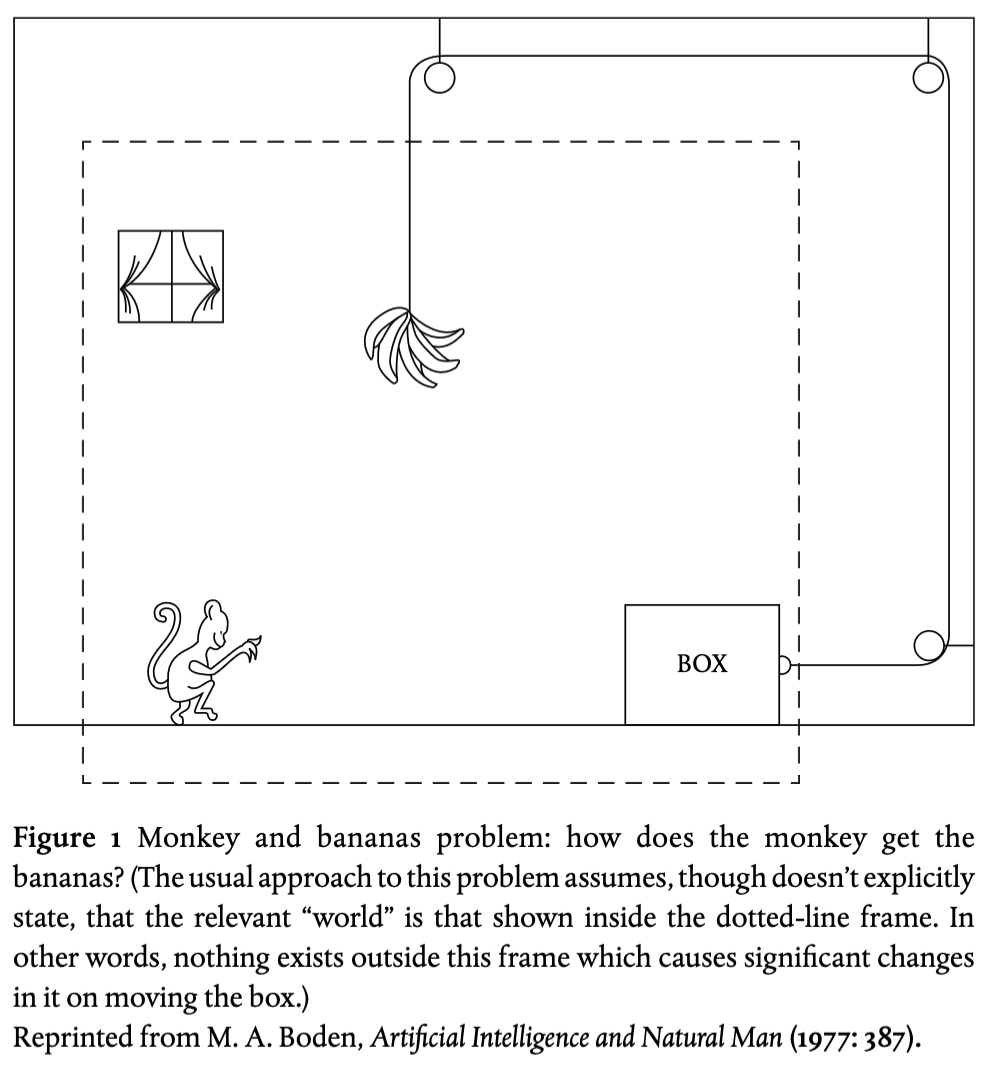
The Frame Problem
AI does not have a human's sense of relevance, look at Boden's funny example: "My own favorite example is: If a man of twenty can pick ten pounds of blackberries in an hour, and a woman of eighteen can pick eight, how many will they gather if they go blackberrying together? For sure, “eighteen” isn’t a plausible answer. It could be much more (because they’re both showing off) or, more probably, much less. This example was even more telling fifty years ago, when I first encountered it. But why is that? Just what kinds of knowledge are involved here? And could an AGI overcome what appear to be the plain arithmetical facts?"
Added by: alexb44
(01/09/2026, 10:25)
|
|
pp. 45–46
"Human-level AGI would involve distributed cognition"
While I understand the connection, it falls flat for me in the sense that there is no such thing as a sociocultural existence for AI agents, so there can be no distinction between them really... It seems to me to be a way of thinking about the problem rather than being an actual part of the problem, precisely because a hypothetical AGI would not have the limitations of humans, so once the system is in place, it would theoretically operate as one and would not actually need distributed cognition.
Added by: alexb44
(01/09/2026, 10:43)
|
|
pp. 50–51
Deep Learning is not the end all be all.
"However (as remarked at the outset of this chapter), full AGI would do very much more. Difficult though it is to build a high-performing AI specialist, building an AI generalist is orders of magnitude harder. (Deep learning isn’t the answer: its aficionados admit that “new paradigms are needed” to combine it with complex reasoning—scholarly code for “we haven”t got a clue”.)" While some still believe LLMs to be the path to AGI, several researchers are leaving this path - LeCun, Sutton and Silver. . .
Added by: alexb44
(01/09/2026, 10:47)
|
|
p. 57
"Some areas of AI seem especially challenging: language, creativity, and emotion. If AI can’t model these, hopes of AGI are illusory"
Added by: alexb44
(01/09/2026, 10:49)
|
|
pp. 69–70
AI can create things that can be deemed creative in Boden's terms:
"In particular, there are very few combinational systems. One might think it’s easy to model combinational creativity. After all, nothing could be simpler than making a computer produce unfamiliar associations of already stored ideas. The results will often be historically novel, and (statistically) surprising. But if they’re also to be valuable, they must be mutually relevant. That’s not straightforward, as we’ve seen. The jokegenerating programs mentioned in Chapter 2 use joke templates to help provide relevance. Similarly, symbolic AI’s case-based reasoning constructs analogies thanks to precoded structural similarities. So, their “combinational” creativity has a strong admixture of exploratory creativity as well." I still maintain that AI's inablity to judge its own output makes the claims of creativity dubious. Humans will often judge their own outputs inaccurately, but they judge them none-the-less, and I think that the framing problem is equally relevant here.
Added by: alexb44
(01/09/2026, 10:54)
|
|
p. 71
"AI has enabled human artists to develop a new art form: computergenerated (CG) art. This concerns architecture, graphics, music, choreography, and—less successfully (given NLP ’s difficulties with syntax and relevance)—literature. In CG art, the computer isn’t a mere tool, comparable to a new paintbrush, helping the artist to do things they might have done anyway. Rather, the work couldn’t have been done, or perhaps even imagined, without it."
This is a false equivalence, in my opinion. Before the paint brush came similar tools, which ultimately led to somebody imagining it in the first place. The very first imagining of what kind of a painting the paint brush would produce is probably very far from the refined concept of painting that we have today, but it could still all be traced further back. Perhaps to chalk on a cavewall, or to cutting in a tree - nevertheless these things paved the way, and at some point the very idea of imagining something as simple as a painting would've been equally unimaginable. What makes the claim to the 'uninmaginativeness' of computer-generated art stronger in this case is that the digital domain does not abide by physical rules, and as such our ability to imagine in the days of less advanced computers was significantly more limited. I can now readily imagine countless different types of CG visual art because we now have cognitive models that allow me to imagine it. Even then, this imaginativeness must have been gradual, but yet with someone having a rough imagination of what drawing on the computer might look like. Once realising a simple version of this, their ability to imagine these artworks gradually expand, so ultimately I see no difference between this example and of other tools. It is a tool all the same, and the argument of "more-than" in this case is not strong.
Added by: alexb44
(01/09/2026, 11:02)
|
|
pp. 76–77
"MINDER indicates some ways in which emotions can control behavior, scheduling competing motives intelligently. A human nursemaid, no doubt, will experience [sic] various types of anxiety as her situation changes. But the point, here, is that emotions aren’t merely feelings. They involve functional, as well as phenomenal, consciousness (see Chapter 6). Specifically, they are computational mechanisms that enable us to schedule competing motives—and without which we couldn’t function. (So the emotionless Mr. Spock of Star Trek is an evolutionary impossibility.)
If we are ever to achieve AGI, emotions such as anxiety will have to be included—and used" While I agree, I think Boden's view here is too strongly suggesting that 'using' emotions as computational mechanisms can really be considered anything like real emotions, and would be severely limited in comparison. Ultimately all this is doing is mimicking the behaviour by introducing something more analogous to a decision tree than actual emotion, making it rather ambiguous. Shouldn't the goal of AGI be a little more lofty than this? Let's even assume we actually program an AGI capable of these computational modes of emotion - how are they regulated and balanced? Human emotions can be both productive and destructive, and that is often a claim to human inferiority as opposed to machines (although hypothetical ones), but humans would still be in charge of determining how they shold be distributed in various situations. Here the AI scientist will point to AGI's potential super ability to determine what is most suitable given literally any situation (which would suggest ASI, not just AGI), but that takes actual emotion to decide, and it isn't necessarilly a process of active reflection, but rather intuition that takes over, so we're back where we started.
Added by: alexb44
(01/09/2026, 11:23)
|
|
p. 100
"Anyone interested in AGI should note that those few AI scientists who have seriously considered the computational architecture of the mind as a whole accept hybridism unreservedly. They include Allen Newell and Anderson (whose SOAR and ACT * were discussed in Chapter 2), Stan Franklin (whose LIDA model of consciousness is outlined in Chapter 6), Minsky (with his “society” theory of mind25), and Aaron Sloman (whose simulation of anxiety is described in Chapter 3).
In short, the virtual machines implemented in our brains are both sequential and parallel. Human intelligence requires subtle cooperation between them. And human-level AGI, if it’s ever achieved, will do so too." Hybridism is an absolute necessity, and so the idea of any definition of AGI that assumes the mind as separate from the body is of no use. (Arxiv 2025 paper re. AGI definition assumes exactly this...) This further stresses the importance of embodiment or embodied intelligence, which is also what Sutton and Silver, and Lecun are gravitating towards (though without the proper reasoning to boot).
Added by: alexb44
(01/09/2026, 11:26)
|
|
p. 104
Female crickets - biological sensing vs robotic "registering".
Added by: alexb44
(07/09/2026, 05:03)
|
| Musings |
|
Do outcomes matter?
Functionalists care only about outcomes when it comes to robotics and AI. But it seems to me that most people care (or should care) for instance whether their partner or close family members remember their birthday. But even if they remember your birthday, it matters how they wish you a happy birthday. If someone who usually rings you up or comes around to celebrate only sends a text message, then you might be disappointed. The functional aspect of congratulating you on your birthday was accomplished, so why then is it not the same?
Added by: alexb44
(07/09/2026, 05:07)
|