Sound Research WIKINDX

Sound Research WIKINDX |
|
 |
|
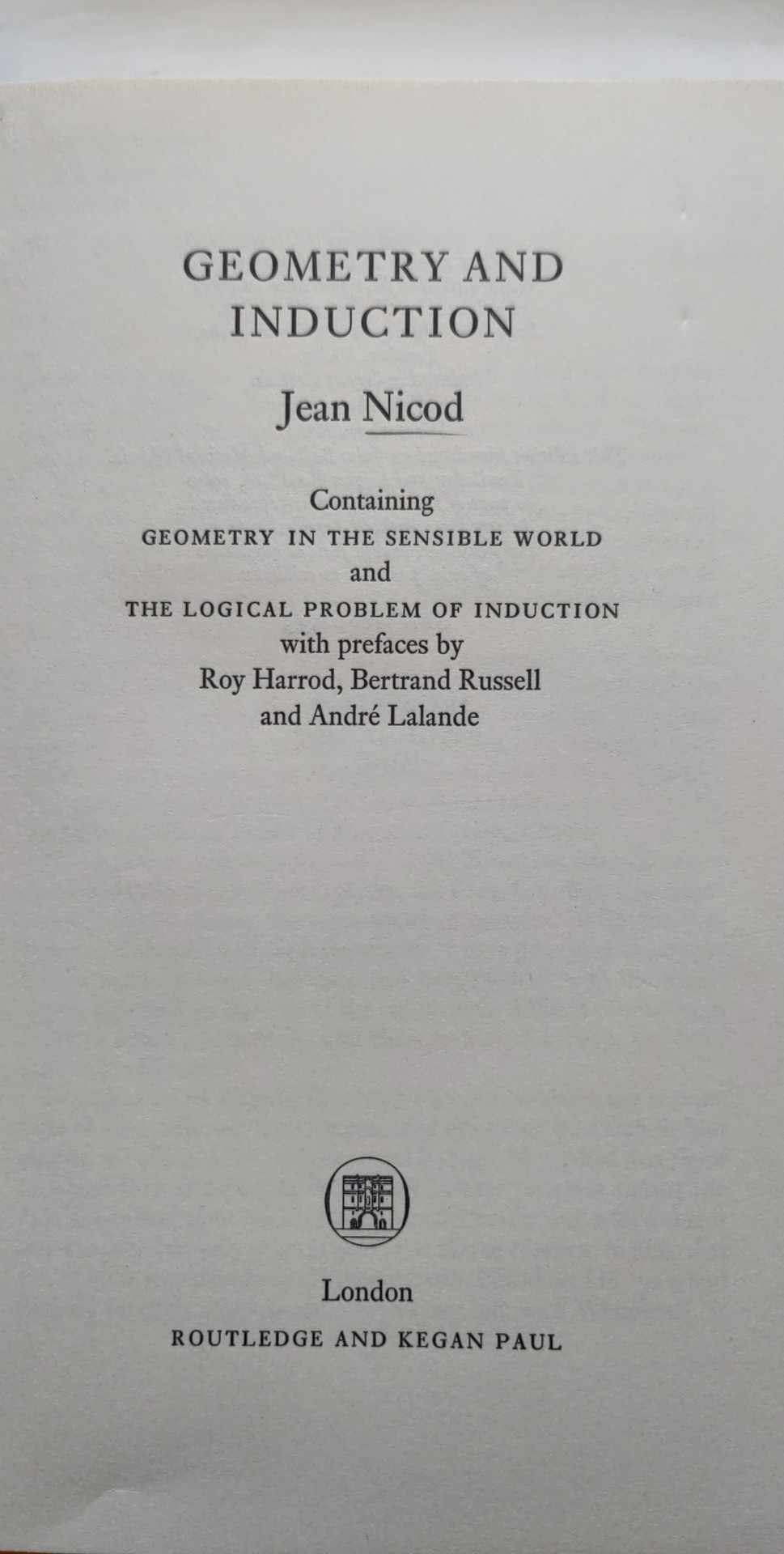
Nicod, J. (1970). Geometry and induction. J. Bell & M. Woods, Trans. London: Routledge and Kegan Paul. (Original work published 1930).
Added by: Mark Grimshaw-Aagaard 17/01/2024, 08:15 Last edited by: Mark Grimshaw-Aagaard 24/01/2024, 09:20 |

|
| Resource type: Book Peer reviewed Published ID no. (ISBN etc.): 7100 6453 5 BibTeX citation key: Nicod1930 Email resource to friend View all bibliographic details  |
Language: en: English Categories: General Keywords: Geometry, Induction, Space Creators: Bell, Nicod, Woods Publisher: Routledge and Kegan Paul (London) Resources citing this (Bibliography: WIKINDX Master Bibliography) |
Views: 1/1475
|
| Notes |
|
pp.77–78 details a thought experiment regarding an individual who has only the sense of audition. By moving along a line that sounds 'notes' at various points (Nicod gives the analogy of moving along an organ keyboard), the individual demonstrates the laws of resemblance (similar notes mean a retracing of steps) and succession (different notes in a set direction). Thus, according to Nicod, is the individual able to sketch a geometry of the line and thus, by extrapolation, a geometry that encompasses our experiences of reality in all its forms. This is used by Nicod to justify geometry as insinuated in all our experiences and thus as fundamental to Nature (see p.71).
Contains two books/theses dealing with different problems: Added by: Mark Grimshaw-Aagaard Last edited by: Mark Grimshaw-Aagaard |
| Quotes |
 p. 71
p. 71
"Let us [. . .] rediscover geometry in the book of nature [. . .] experience rests not on space, but on bodies, or more generally on the sensible. However, geometry insinuates itself into the expression of any experience through the situations of the objects and observers, which are part of the circumstances of any sensible fact."
Added by: Mark Grimshaw-Aagaard
17/01/2024, 08:20
|
|
p. 173
"we see two types of induction. One proceeds by a simple enumeration of instances. It bases itself solely on their number, and does not claim to derive from that aything but a probability, which may be more or less strong. The other, however, proceeds by the analysis of circumstances. Being sure of itself, it relies entirely on care, and not at all on repetition, and it aims at certainty. Of these two types of induction, only the latter seems to correspond to the practice and even the spirit of science. A single experience, the scientist thinks, provided that every care has been taken, can bring us at a single stroke all the certainty that is attainable; to wish to build anything whatever on repetition is unworthy of the intelligence."
Added by: Mark Grimshaw-Aagaard
24/01/2024, 09:11
Keywords: Induction |
|
p. 174
Critically quotes Francis Bacon: "Inductio per enumerationem simplicem precario concludit et periculo exponitur ab instantia contradictoria"
Added by: Mark Grimshaw-Aagaard
24/01/2024, 09:17
Keywords: Induction |